


Introduction
The Constitution of India is more than just the country’s governing document—it is the foundation of democracy, justice, liberty, equality, and dignity for every citizen. One of its most significant features is the inclusion of Fundamental Rights, which are designed to protect individuals against arbitrary actions by the State and ensure equal treatment under the law.
These rights empower citizens to live with freedom and dignity while providing legal remedies if those rights are infringed. Whether it is freedom of speech, protection against discrimination, or the right to seek justice before constitutional courts, Fundamental Rights form the cornerstone of India’s democratic framework.
This article explains the different Fundamental Rights available to Indian citizens, their importance, limitations, and the remedies available when these rights are violated.
What Are Fundamental Rights?
Fundamental Rights are a set of basic human rights guaranteed by Part III of the Constitution of India (Articles 12 to 35). They are enforceable by law, meaning that if any of these rights are violated, an individual can approach the appropriate court for relief.
The primary objective of these rights is to ensure fairness, equality, and protection from arbitrary state action while preserving individual liberty.
Initially, the Constitution contained seven Fundamental Rights. However, after the 44th Constitutional Amendment (1978), the Right to Property ceased to be a Fundamental Right and became a constitutional legal right under Article 300A.
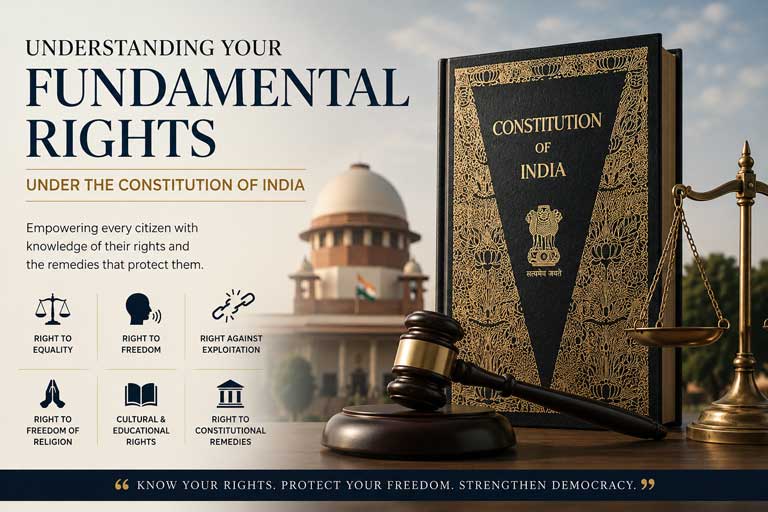
The Six Fundamental Rights
1. Right to Equality (Articles 14–18)
The Right to Equality ensures that every person is treated equally before the law.
It includes:
- Equality before law.
- Equal protection of laws.
- Prohibition of discrimination based on religion, race, caste, sex, or place of birth.
- Equality of opportunity in public employment.
- Abolition of untouchability.
- Abolition of titles (except military and academic distinctions).
This right ensures that no individual is above the law and promotes fairness in governance.
2. Right to Freedom (Articles 19–22)
The Right to Freedom is among the most widely exercised Fundamental Rights.
It guarantees several freedoms, including:
- Freedom of speech and expression.
- Freedom to assemble peacefully.
- Freedom to form associations or unions.
- Freedom to move freely throughout India.
- Freedom to reside anywhere in the country.
- Freedom to practice any profession or carry on any occupation, trade, or business.
The Constitution also provides protection against arbitrary arrest and detention by prescribing procedural safeguards.
However, these freedoms are not absolute. Reasonable restrictions may be imposed in the interests of national security, public order, morality, decency, or the sovereignty and integrity of India.
3. Right Against Exploitation (Articles 23–24)
This right protects individuals from forced labour and exploitation.
It prohibits:
- Human trafficking.
- Begar (forced labour without payment).
- Child labour in hazardous occupations.
The objective is to preserve human dignity and eliminate exploitative practices that violate basic human rights.
4. Right to Freedom of Religion (Articles 25–28)
India is a secular nation where every individual enjoys the freedom to:
- Profess any religion.
- Practice religious beliefs.
- Propagate religion peacefully.
- Establish and manage religious institutions.
The State maintains neutrality among religions while ensuring public order, morality, and health.
5. Cultural and Educational Rights (Articles 29–30)
India is home to diverse cultures, languages, and traditions.
These provisions protect:
- The right of minorities to preserve their language, script, and culture.
- The right of minorities to establish and administer educational institutions.
These rights strengthen India’s pluralistic and inclusive society.
6. Right to Constitutional Remedies (Article 32)
Dr. B.R. Ambedkar famously described Article 32 as the “Heart and Soul of the Constitution.”
This right empowers citizens to directly approach the Supreme Court for enforcement of Fundamental Rights.
Similarly, Article 226 empowers High Courts to issue constitutional writs for enforcement of rights.
Without this remedy, Fundamental Rights would have little practical value.
Constitutional Writs Available to Citizens
When Fundamental Rights are violated, constitutional courts may issue one of the following writs:
Habeas Corpus
Issued to secure the release of a person who has been illegally detained.
Mandamus
Directs a public authority to perform its legal duty.
Certiorari
Quashes an order passed by an inferior court or tribunal where jurisdictional errors or legal infirmities exist.
Prohibition
Restrains a lower court or tribunal from proceeding in excess of its jurisdiction.
Quo Warranto
Challenges the authority of a person unlawfully occupying a public office.
These writs are powerful constitutional tools for protecting citizens against unlawful governmental action.
Are Fundamental Rights Absolute?
No.
Although Fundamental Rights are essential, they are subject to reasonable restrictions. Courts balance individual freedoms with larger public interests such as:
- National security.
- Public order.
- Public health.
- Morality.
- Friendly relations with foreign states.
- Prevention of incitement to offences.
The judiciary plays a crucial role in ensuring that such restrictions remain reasonable and constitutional.
Why Fundamental Rights Matter
Fundamental Rights are essential because they:
- Protect individual liberty.
- Promote equality before law.
- Prevent abuse of governmental power.
- Strengthen democracy.
- Safeguard minority interests.
- Ensure fair treatment by public authorities.
- Uphold human dignity.
These rights create accountability and reinforce the rule of law, ensuring that governmental actions remain subject to constitutional scrutiny.
When Should You Seek Legal Assistance?
You should consider consulting a legal professional if you believe your constitutional rights have been violated. Common situations include:
- Illegal arrest or detention.
- Discrimination by public authorities.
- Unlawful denial of government benefits.
- Violation of free speech rights.
- Arbitrary administrative action.
- Denial of natural justice.
- Infringement of religious or educational rights.
Prompt legal advice can help identify the appropriate legal remedy and protect your interests effectively.
Conclusion
Fundamental Rights are not merely constitutional provisions—they are the foundation of a free, democratic, and just society. They ensure that every individual is treated with equality, dignity, and fairness while providing effective remedies against unlawful actions.
However, these rights must also be exercised responsibly and within the framework of the Constitution. Understanding your constitutional protections enables you to safeguard your interests and contribute to a society governed by the rule of law.
Whether you are an individual, a business owner, or a public servant, awareness of Fundamental Rights empowers you to make informed decisions and seek justice whenever necessary.
Frequently Asked Questions (FAQs)
1. What are Fundamental Rights?
Fundamental Rights are basic constitutional rights guaranteed under Part III of the Constitution of India to protect the liberty, equality, and dignity of individuals.
2. Can Fundamental Rights be restricted?
Yes. They are subject to reasonable restrictions imposed in the interests of public order, national security, morality, and other constitutional considerations.
3. Which court can enforce Fundamental Rights?
The Supreme Court under Article 32 and the High Courts under Article 226 can enforce Fundamental Rights through constitutional writs.
4. Can private individuals violate Fundamental Rights?
Most Fundamental Rights are enforceable against the State and public authorities. However, certain rights, such as protection against exploitation, may also apply against private individuals in specified circumstances.
5. What should I do if my Fundamental Rights are violated?
You should consult a qualified advocate to determine the appropriate legal remedy, which may include filing a writ petition before the High Court or the Supreme Court, depending on the facts of the case.
Disclaimer
This article is intended solely for informational and educational purposes and should not be construed as legal advice or a legal opinion. Every legal matter is unique and depends upon its specific facts and applicable laws. Readers are advised to seek professional legal counsel before taking any action based on the information contained in this article.