


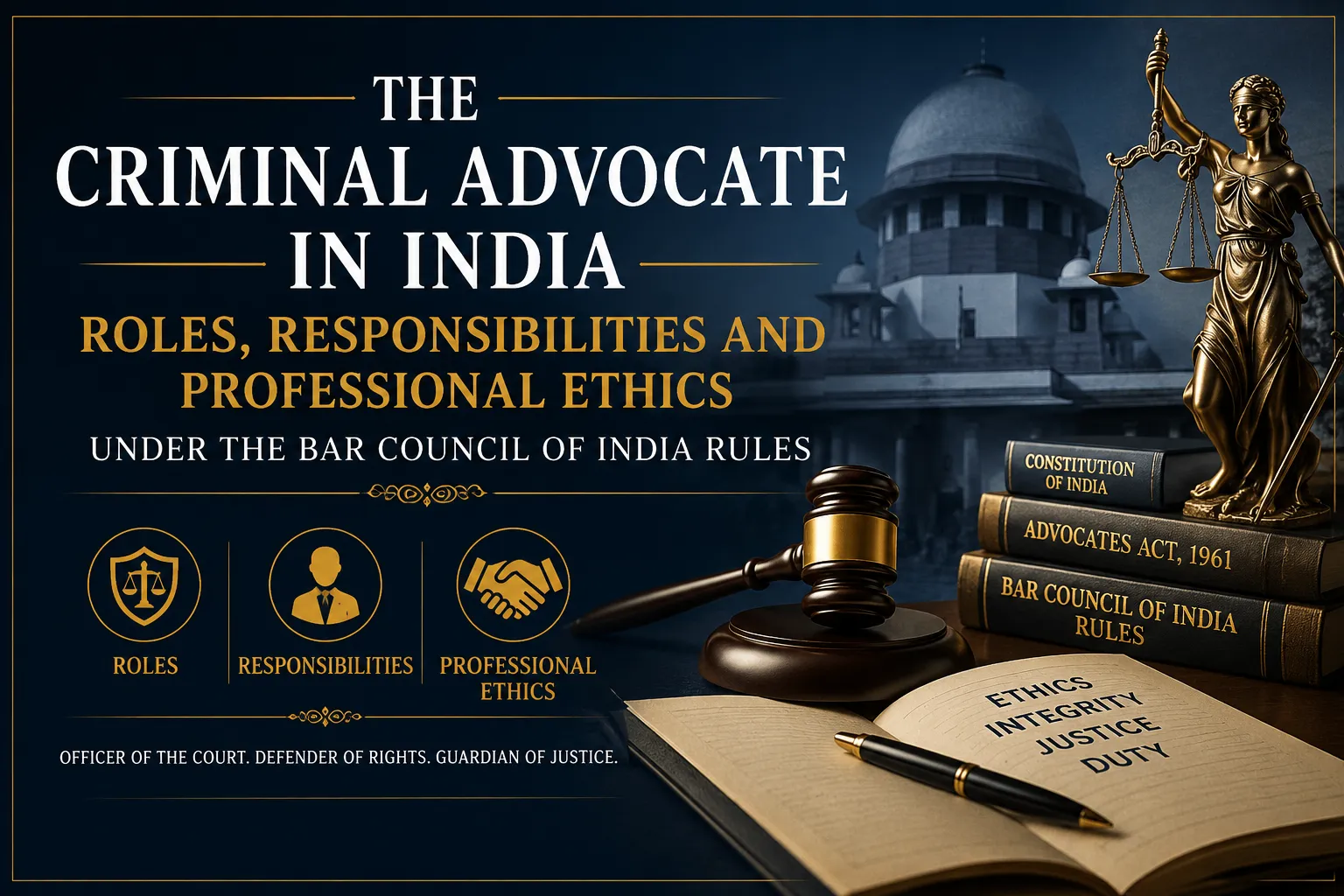
Judicial observations by the Supreme Court and High Courts on the role, duties, ethics, and responsibilities of criminal advocates, here are some of the most authoritative judgments:
1. R.K. Anand v. Registrar, Delhi High Court
Key Principle:
- An advocate is an officer of the court, not merely an agent of the client.
- Criminal advocates must maintain the highest standards of integrity.
- Fabricating evidence, influencing witnesses, or interfering with justice amounts to professional misconduct.
Notable observation:
“The duty of an advocate is first to the court, then to the client.”
2. D.P. Chadha v. Triyugi Narain Mishra
Key Principle:
- Advocates are expected to uphold dignity, fairness, and honesty.
- Success in litigation cannot justify unethical conduct.
3. O.P. Sharma v. High Court of Punjab & Haryana
Key Principle:
- Advocates owe respect to judges and the institution of the judiciary.
- Misconduct by advocates undermines the administration of justice.
4. Mahipal Singh Rana v. State of Uttar Pradesh
Key Principle:
- The legal profession is a noble profession.
- Courts have the power to take action against advocates whose conduct obstructs justice.
5. P.D. Gupta v. Ram Murti
Key Principle:
- Lawyers must act honestly and in the client’s best interests.
- Professional misconduct includes misleading clients or the court.
6. Ex-Capt. Harish Uppal v. Union of India
Key Principle:
- Advocates have a duty to appear in court.
- Strikes and boycotts by lawyers are generally illegal because they impede justice.
7. A.S. Mohammed Rafi v. State of Tamil Nadu
Key Principle:
- Every accused has a constitutional right to legal representation.
- No advocate or bar association can prevent another advocate from defending an accused, regardless of the nature of the allegations.
8. Hussainara Khatoon v. State of Bihar
Relevance to Criminal Advocates:
- Legal aid is an essential component of a fair criminal justice system.
- Criminal advocates play a vital role in protecting the constitutional rights of indigent accused persons.
9. Mohd. Hussain @ Julfikar Ali v. State (NCT of Delhi)
Key Principle:
- Effective legal representation is integral to a fair trial under Article 21.
- A criminal advocate must provide meaningful and competent defence, not merely a formal appearance.
10. State of Uttar Pradesh v. Shambhu Nath Singh
Key Principle:
- Defence counsel must assist the court in discovering the truth while safeguarding the rights of the accused.
- A criminal advocate should never mislead the court or suppress material facts.
Common Judicial Principles on Criminal Advocates
The courts have consistently held that a criminal advocate must:
- Be an officer of the court before being a representative of the client.
- Defend the accused fearlessly but within the bounds of law.
- Maintain client confidentiality.
- Avoid coaching witnesses or fabricating evidence.
- Assist the court in the administration of justice.
- Conduct cross-examination fairly and professionally.
- Preserve independence from external pressures.
- Uphold the dignity of the legal profession.
- Follow the ethical standards prescribed under the Advocates Act, 1961 and the Bar Council of India Rules.
These judgments, together with the Bar Council of India Rules (Part VI, Chapter II – Standards of Professional Conduct and Etiquette), form the core jurisprudence on the professional duties and ethics of criminal advocates in India.