


Introduction
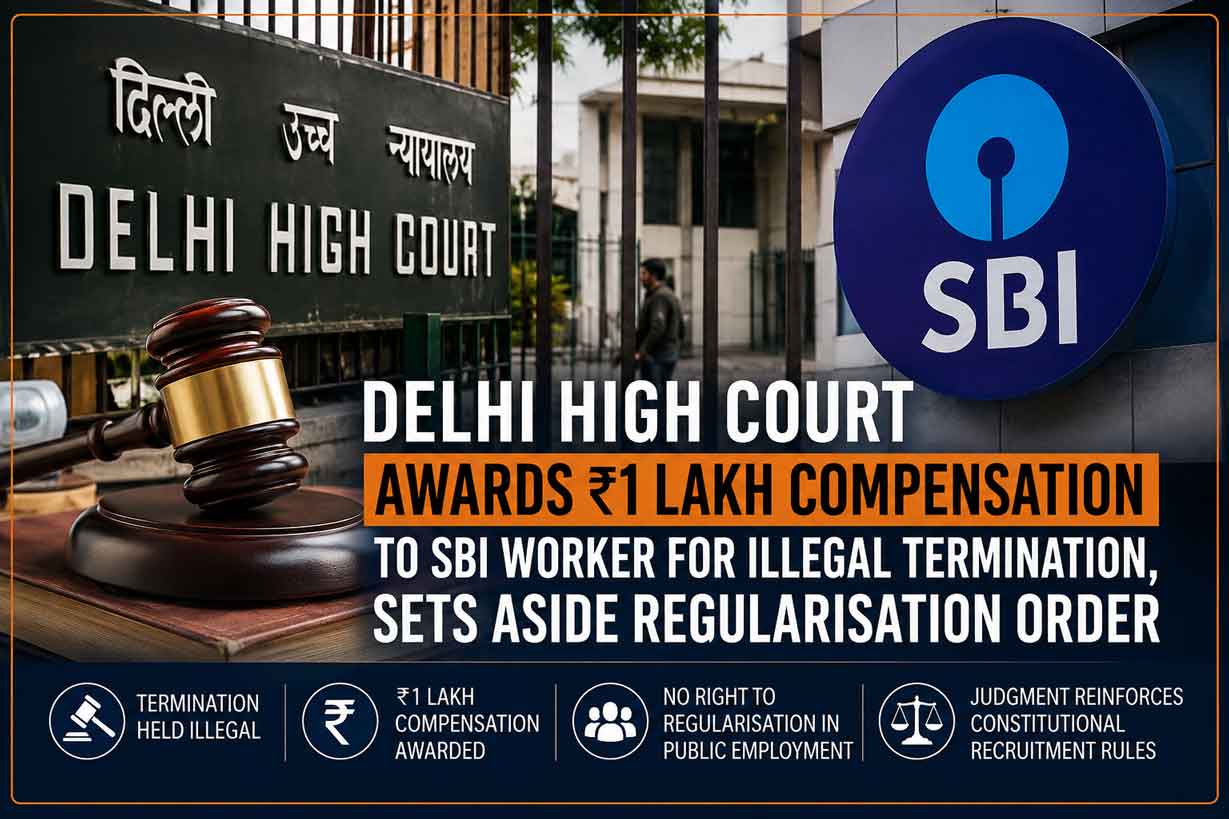
In a significant judgment balancing the rights of workers with constitutional principles governing public employment, the Delhi High Court has held that although the termination of a worker by the State Bank of India (SBI) was illegal, such illegality does not automatically entitle the employee to permanent regularisation.
Justice Shail Jain set aside a Labour Court award that had directed SBI to regularise the services of the workman while simultaneously upholding the finding that his termination violated the provisions of the Industrial Disputes Act, 1947. Instead of reinstatement or regularisation, the Court awarded the worker a lump sum compensation of ₹1 lakh, reiterating that public employment must strictly comply with constitutional requirements under Articles 14 and 16.
Background of the Case
The dispute arose after the concerned workman challenged the termination of his services by the State Bank of India. The matter eventually reached the Labour Court, which examined whether the bank had complied with the mandatory provisions governing retrenchment under the Industrial Disputes Act, 1947.
The Labour Court found that SBI had failed to comply with Section 25F of the Industrial Disputes Act before terminating the employee. Consequently, it held the termination to be illegal.
However, instead of merely granting relief for the illegal termination, the Labour Court went a step further and directed SBI to regularise the services of the employee.
Aggrieved by this direction, SBI approached the Delhi High Court challenging the award, particularly the order directing regularisation.
What Section 25F Requires
Section 25F of the Industrial Disputes Act provides mandatory safeguards before retrenching a workman who has completed the prescribed period of continuous service.
An employer is generally required to:
- Give one month’s prior notice or wages in lieu of notice.
- Pay retrenchment compensation.
- Follow the statutory procedure prescribed under the Act.
Failure to comply with these requirements renders the retrenchment illegal.
In this case, the Court agreed that SBI had not complied with these statutory obligations. (Delhi High Court)
Delhi High Court’s Observations
Justice Shail Jain clarified an important distinction between an illegal termination and an entitlement to permanent employment.
The Court observed that merely because an employer violates the Industrial Disputes Act does not mean that a worker acquires a legal right to be regularised in public service.
The judgment reiterated that appointments in government departments and public sector undertakings must satisfy constitutional requirements of equality and fair recruitment.
Regularisation cannot be used as a substitute for a valid recruitment process.
The Court relied upon settled principles laid down by the Supreme Court that public employment must comply with Articles 14 and 16 of the Constitution, ensuring equal opportunity to all eligible candidates.
Accordingly, the Labour Court exceeded its jurisdiction by directing regularisation of the employee.
Compensation Instead of Regularisation
While setting aside the order directing regularisation, the High Court did not ignore the illegality committed by the employer.
Recognising that the workman had suffered because of an unlawful termination, the Court directed SBI to pay ₹1 lakh as compensation.
The Court considered compensation to be a more appropriate remedy than granting permanent employment, especially where the initial appointment itself did not satisfy the constitutional requirements governing recruitment in public service.
Why Regularisation Was Rejected
The High Court explained that regularisation is not an automatic consequence of illegal retrenchment.
Some of the important reasons include:
- Public sector appointments must follow a transparent recruitment process.
- Courts cannot bypass constitutional requirements by directing permanent appointments.
- Labour Courts cannot create a right of regularisation where none exists in law.
- Relief must remain proportionate to the legal violation committed by the employer.
The Court emphasised that granting regularisation without following the constitutional recruitment framework would prejudice other eligible candidates waiting for public employment opportunities.
Significance of the Judgment
The ruling reinforces several well-established principles of labour law.
1. Illegal Termination Does Not Automatically Mean Permanent Employment
A finding that termination violated labour laws does not automatically result in reinstatement or regularisation.
Each case must be examined on its own facts.
2. Constitutional Requirements Prevail
Where the employer is a government body or public sector undertaking, constitutional principles governing recruitment cannot be ignored.
3. Compensation Can Be an Appropriate Remedy
Courts increasingly recognise that monetary compensation may adequately balance the interests of both employer and employee in appropriate cases.
4. Labour Courts Have Limited Powers
Labour Courts cannot grant relief beyond what the law permits.
Even where termination is illegal, they must remain within the legal framework while granting remedies.
Impact on Public Sector Employers
The judgment provides important guidance for public sector organisations, including banks and government undertakings.
It reiterates that:
- Statutory retrenchment procedures must always be followed.
- Violations may result in compensation or other relief.
- However, failure to follow labour laws will not necessarily compel the employer to permanently absorb the employee.
This distinction protects both workers’ statutory rights and the constitutional principles governing public employment.
Impact on Employees
Employees challenging wrongful termination should understand that:
- Courts will examine whether statutory procedures were followed.
- Illegal termination may entitle them to compensation.
- Reinstatement or regularisation will depend upon the facts of each case.
- Public employment carries additional constitutional requirements that private employment may not.
Key Takeaways
- The Delhi High Court held that SBI illegally terminated the services of the workman by violating Section 25F of the Industrial Disputes Act.
- The Labour Court’s direction to regularise the employee was set aside.
- The Court ruled that illegal termination does not automatically create a right to regularisation in public employment.
- SBI was directed to pay ₹1 lakh as compensation to the worker.
- The judgment reinforces the constitutional principles governing recruitment in government and public sector institutions.
Frequently Asked Questions (FAQs)
1. Why did the Delhi High Court set aside the Labour Court’s order?
Because the Labour Court exceeded its jurisdiction by directing regularisation, which is not an automatic consequence of illegal termination in public employment.
2. Was SBI found guilty of illegal termination?
Yes. The Court upheld the finding that SBI failed to comply with Section 25F of the Industrial Disputes Act before terminating the worker. (Delhi High Court)
3. Did the worker get reinstated?
No. The High Court awarded ₹1 lakh as compensation instead of reinstatement or regularisation.
4. Can an illegally terminated employee always demand regularisation?
No. Courts have consistently held that regularisation depends upon the legality of the initial appointment and compliance with constitutional recruitment requirements.
5. What is the importance of this judgment?
The decision clarifies that while employers must follow labour laws, remedies in public employment must also respect constitutional principles governing recruitment and equal opportunity.
Disclaimer
This article is intended solely for general informational and educational purposes and should not be construed as legal advice. The discussion is based on publicly available reports of the Delhi High Court’s judgment and may not capture every factual or legal aspect of the case. Readers facing employment or labour law disputes should consult a qualified legal professional for advice tailored to their specific circumstances.